Work: a refuge in turbulent times?
Why employees are staying the course with confidence amid the threat of inflation and the rise of AI.

One year after releasing our first global study, The New Rules of Engagement, Pluxee is back with an equally ambitious follow-up examining how employee engagement is evolving amid growing global uncertainty and AI reshaping the world of work as we know it.
Drawing on insights from employees across a variety of countries, ages, and sectors, the research identifies three major paradoxes that challenge conventional assumptions about how much people value work, the conditions for their loyalty to their company, and workers’ attitudes toward AI.
Overall, workers’ outlook is currently remarkably positive, with 76% saying they feel ‘enthusiastic’, ‘happy’, or ‘confident’. This is despite half of them admitting they are worried about their country’s and the planet's future, while a further 70% say that inflation and its impact on their purchasing power is their number one concern now.
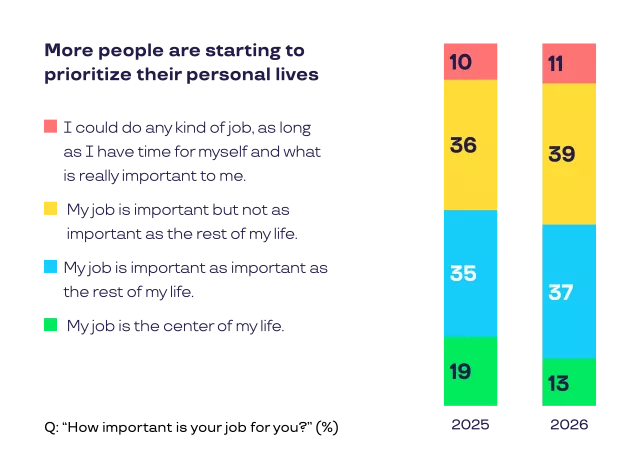
Employees are increasingly setting boundaries at work as they prioritize their personal lives. Nevertheless, they continue to report high satisfaction with their work and a strong attachment to their organizations, suggesting that work has become a source of stability and even a refuge in uncertain times.
The share of employees who say work is the center of their lives (6% decrease from 2025)
The average rating employees across all countries give when asked to score their professional satisfaction
The share of workers who say they either ‘love’ or ‘like’ their company (4% increase from 2025)
With employees devoting more time to the home front and adopting a more measured approach to their work, one might assume they value their jobs less. Yet the data tells a different story. Professional satisfaction remains high (above 7 in all countries). Meanwhile, 87% report that they either ‘love’ or ‘like’ their organization, up 4 percentage points from last year.
As traditional institutions fade, the workplace remains a place where adults see peers daily, share experiences, participate, feel connected to others, and thrive.
Jean-Baptiste Barfety
Public policy expert on the transformation of work and the role of the company in society
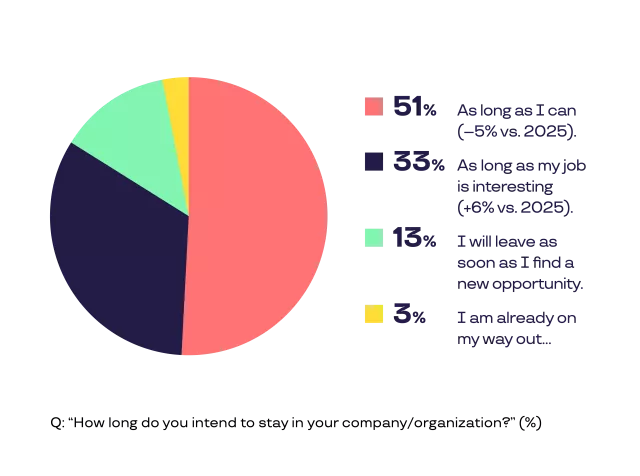
Despite economic uncertainty, job loss ranks among employees’ lowest concerns. Yet their loyalty has become increasingly conditional. The main takeaway here is that people are prepared to go elsewhere if their company doesn’t provide a sense of well-being, sufficient recognition, and an interesting job.
The decline in the number of employees who say ‘I intend to stay as long as I can’ in their jobs compared to 2025
The increase in the number of employees who say ‘I intend to stay as long as my job remains interesting’ compared to last year
The share of employees who expect HR to prioritize ‘employee well-being and working conditions’
Responses expressing conditional loyalty (‘I intend to stay as long as my job remains interesting’) are up by 6 points overall, with the largest increases in Western Europe, from senior to Gen Z employees. This echoes last year’s study, which found that employees expected reciprocity from their organizations in return for their engagement.
The data shows that workers are increasingly seeking rewards that match their real needs, while boosting productivity, creativity, engagement, and excellence at work.
Jean-Baptiste Barfety
Public policy expert on the transformation of work and the role of the company in society
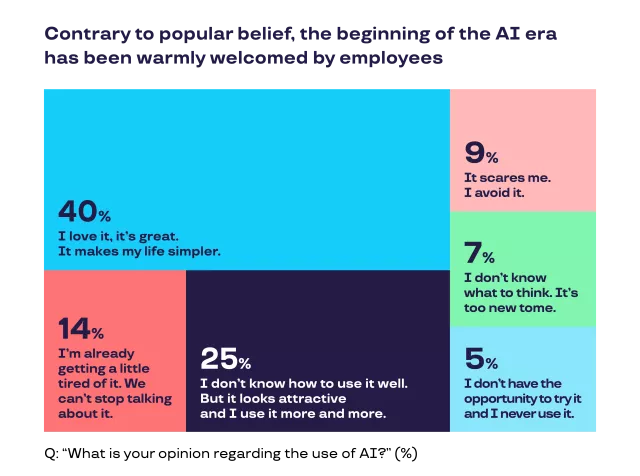
Today’s employees welcome the AI revolution, with a large share convinced that this technology will improve rather than replace their jobs. Workers expect AI to reduce repetitive tasks, simplify everyday work, and make their roles more fulfilling. More than half use this technology regularly.
The share of employees who welcome the AI revolution
The percentage of workers confident that their jobs will not become obsolete due to AI
The share of workers who believe that the content of their jobs will most likely change, ‘but in a positive way’, as AI will make their jobs ‘less routine and more interesting’
The AI revolution is welcomed by 65% of employees. With an astonishing 40% describing AI as ‘great’ and saying they ‘loved’ using it. This pro-AI contingent is particularly strong in Turkey and in the Americas, including the USA, Chile, Brazil, Mexico, and Colombia. A further 25% of workers admitted that, although they were not well acquainted with AI tools, they find them attractive and are keen to use them more regularly.
The vast majority of employees are not worried about losing their jobs. AI is still in its early stages, and so far, the experience has been positive — it’s helpful, it saves time, and it’s convenient.
Antoine Solom
Senior Consultant at Focus, specializing in research, advisory, and strategy for engaging transformations
At a time when employees are navigating economic uncertainty, shifting expectations around work and the rise of AI, we brought together two leading experts to help make sense of these transformations. Their insights shed light on the paradoxes shaping employees’ relationship with work today - from their growing connection to their company to changing expectations around loyalty and the surprisingly positive response to AI.
Jean-Baptiste Barfety
Public policy expert on the transformation of work and the role of the company in society
Jean-Baptiste Barfety is known for highlighting the structural and policy factors shaping today’s pursuit of meaningful work. This year, he turned his attention to AI. He brought together 17 companies (representing 1.5 million employees) and drew on an international literature review and working groups with HR leaders and frontline managers to write Working with AI, Deciding Among Humans (Projet Sens, May 19, 2026), his latest report. Barfety – a co-leader of a research group at Collège des Bernardins focused on work, a former advisor to the French Ministry of Labor, and the rapporteur for the influential Notat- Senard Report that shaped French legislation on purposedriven companies – bridges academic insights and corporate realities.
Antoine Solom
Senior Consultant at Focus, specializing in research, advisory, and strategy for engaging transformations
Antoine Solom shares his expertise in driving business transformation for global organizations. Solom previously spent thirty years at Ipsos, notably as Lead Managing Director of its HR Analytics and Consulting Solutions department, with a focus on Engaging Work Cultures.
Read our previous international study to learn why modern-day engagement is no longer about employees unquestioningly giving their all to their organization, but rather about the two sides establishing a relationship based on reciprocity, as each worker mindfully strikes the right balance for them between work, life, and beyond.